 Get a Quote
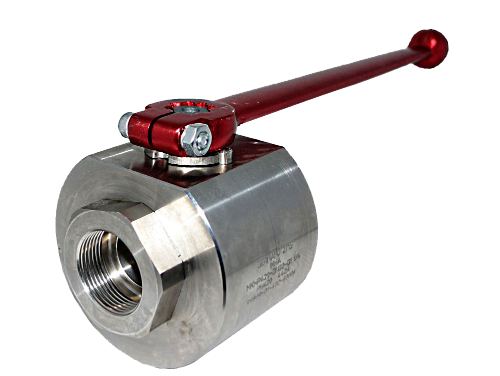
High Pressure Valves
High Pressure Ball Valves
High Pressure Ball Valves. Full or reduced bore; tight bubble-tight shut-off with PTFE seats; ideal for on/off isolation, not throttling. Body in SS316, rated High Pressure (to 420–500 BAR). Material selected to suit the medium and pressure.
- Bubble-tight shut-off (soft-seated types)
- Corrosion-resistant materials
- Ex-stock in common sizes
- Actuation options on request
Specifications
| Size Range | 1/8" to 2 1/2" |
|---|---|
| Design | Quarter Turn Type |
| Material | Steel SS316 |
| Working Pressure | Up to 700 BAR |
| Connections | BSPP NPT DIN2353 |
| Applicable Medium | General Hydraulic Oil (Gas Application on request) |
| Temperature Range | Steel : -20°C to +100°C SS316 : -30°C to +100°C |
| Ball Seats | POM standard option, other materials on request |
| Stem and Adaptor Sealing Materials | NBR standard option, other materials on request |
Specifications are indicative and vary by size and manufacturer. Request the full datasheet for exact dimensions, materials and certification.
Typical applications
- Hydraulic power units and manifolds
- Load-holding and isolation duties
- Test rigs and high-pressure instrumentation
Ordering & procurement
Ex-stock in Singapore, dispatched within 3 working days. Material / mill certificates (EN 10204 3.1) and export documentation available. Special sizes and materials sourced on request.
Request a quoteProduct information
High pressure ball valves are quarter-turn ball valves that use a floating ball in controlling flow. The valve is open when the ball’s holes are in line with the flow, and closed when pivoted at 90-degrees using the valve handle. Ball valves are durable and retains its quality after many cycles.
Our range of hydraulic ball valves has a working pressure of up to 700 Bar and varies sizes. Hydraulic high pressure ball valves are usually made from steel and stainless steel materials. The common connection for high pressure ball valves are threaded type or compression type.
Product information
1. Specifications:
High pressure ball valves are hydraulic ball valves that used to control, restrict or shut off liquids and gases in the system line . It is a quarter-turn ball valve which uses a floating ball to control the flow . The flow will go through when the hollow ball is in line with it and close when pivoted the handle by 90˚ rotation. High pressure ball valves are commonly used in construction and agricultural, fire protection, marine & offshore, oil & gas, and process industry. Due to its difficulty to clean, they are not recommended for the purpose of food and beverages, and pharmaceutical.
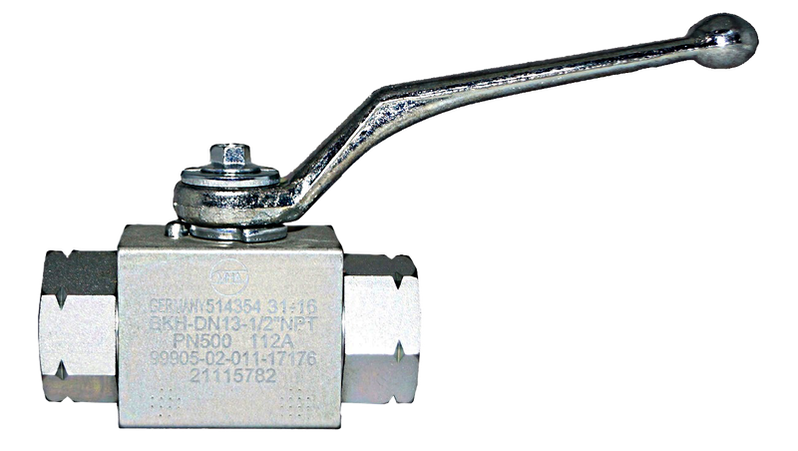
BKH Type Quarter Turn High Pressure Ball Valve
2. Material:
The available material for high pressure ball valve is Steel (112A/212A/192A) and Stainless Steel (442A). The material combination code is representing the material for body and adapters, ball and stem, ball seat, and sealing on stem and adapters respectively. For more information about material details, please refer to the MHA Catalogue.
It is important to know the type of applications, and working temperature to determine the material for ball valves parts such as ball seat, and seal for stem and adaptor. For Steel material, the temperature range are from -20˚C to 100˚C. For Stainless Steel material, the temperature range are from -30˚C to 100˚C.
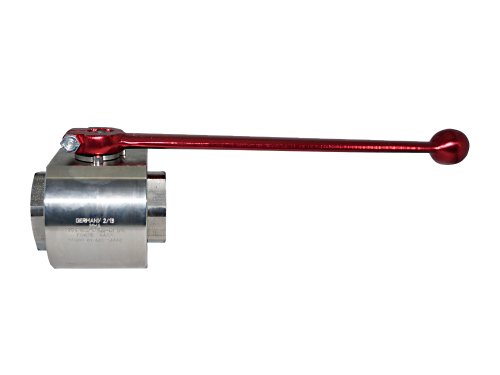
MKH Type Quarter Turn High Pressure Ball Valve
3. Size Range & Pressure Rating:
The available sizes for high pressure ball valves are ranged from 1/8" to 2 1/2" . There are two different types of ball valve body design. For sizes ranged from 1/8" to 1 1/2", the ball valves are design in BKH type (square body) . While for sizes ranged from 1 1/4" to 2 1/2", the ball valves are design in MKHP type (round or hexagon body) . Reduced bore type ball valves are also available for certain sizes. For BKH type , the maximum working pressure range is from 315 Bars to 500 Bars , depending on the ball valve sizes. For MKHP type , the maximum working pressure is 420 Bars .
4. Connection Type:
The common available connection for high pressure ball valve is NPT (National Pipe Thread) and BSPP (British Standard Pipe Parallel). For NPT thread , it is according to ANSI B1.20.1 while for BSPP thread , it is according to DIN ISO 228 . There are other connection types that are available upon request which is Compression type (DIN 2353/ISO 8434-1), SAE J514 female thread, ISO 7/1 Rc female thread, and ISO 8434-3 ORFS male thread. For more information regarding ball valves, please refer to en.wikipedia.org/wiki/Ball_valve .
5. Installation of High Pressure Ball Valves:
Please reference the checklist before, during and after installation instruction below to ensure a proper installation of a high pressure ball valve:
Checklist before installation:
- Before installing the ball valve, it must be fully checked to ensure that it matches the required design and is acceptable for the intended usage.
- Installation of ball valves can be done by qualified personnel when both the ball valve and pipe system are unpressurized. The pipelines must be inserted into the fittings without tension.
- Before installation, all pipelines must be inspected for damage and contamination.
- Internal parts of valves can be damaged by residue in pipelines, resulting in malfunction or full failure of valve operation.
Checklist during installation:
- Make sure the ball valve is not subjected to any external tensions or vibrations.
- Use an appropriate tool when screwing the piping screw into the ball valve.
- On ball valves with welded ends, overheating of the seals must be avoided by using appropriate tools.
- Before all the screws on the flange connection are tightened crosswise, the ball valve on the flange end connection must be centered by screwing the counter flange.
Checklist after installation:
- A function test must be done after the valve has been installed.
- No parts of the ball valve (e.g. body, adaptor, connection piece) can be released or screwed down.
- It must be ensured that the pipe system and ball valve are entirely emptied, in case of media that is hazardous to health, flammable or explosive.
Following these instructions will prevent leaks as fluids pass through. Prior to the first operation, all operating instructions must be properly read and followed, and all assembly work must be thoroughly checked. In every installation, professional execution is crucial.
← To go back to High Pressure Valves page
FAQ Of High Pressure Ball Valves
What is the size range of hydraulic ball valves?
The size range of hydraulic ball valves is from 1/8 inches to 4 inches.
What is the function of hydraulic ball valves?
Fluid flow is regulated by high pressure ball valves in both closed and open positions. Ball valves are suitable for use in piping systems where all connections have the same pressure load.
What is the working pressure for hydraulic ball valves?
Hydraulic ball valves withstand a pressure of up to 700 bar, subjected to the valve size.
Which fields/ industries would apply ball valves?
There are many fields of use for using a ball valve:
- Hydraulics system
- Chemical and petrochemical industry
- Off-shore, water, high pressure cleaning systems
- Mining Industry
- Agricultural machinery
- Gas pipelines
How to lock a ball valve?
You can lock a ball valves with several accessories options such as locking devices, detent, pneumatic and electric actuator or a limit switch.
What are the different categories and optimum temperature of hydraulic ball valves ?
Stainless Steel SS316 and Carbon Steel are two categories of hydraulic ball valves. The suggested temperature range for MHA valves is -20°C to +100°C for steel valves and -30°C to +100°C for SS316 valves.
Specifications
Technical data
| Size Range | 1/8" to 2 1/2" |
|---|---|
| Design | Quarter Turn Type |
| Material | Steel SS316 |
| Working Pressure | Up to 700 BAR |
| Connections | BSPP NPT DIN2353 |
| Applicable Medium | General Hydraulic Oil (Gas Application on request) |
| Temperature Range | Steel : -20°C to +100°C SS316 : -30°C to +100°C |
| Ball Seats | POM standard option, other materials on request |
| Stem and Adaptor Sealing Materials | NBR standard option, other materials on request |
Having a hard time finding the right parts?
We stock 15,000+ line items and can source specials nobody else can. Get a quotation within 2 hours.