 Get a Quote
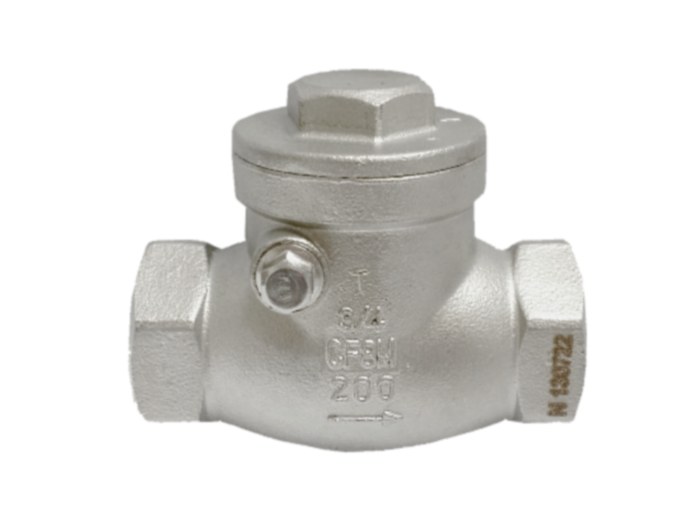
Low Pressure Valves
Swing Check Valves
A comprehensive range of industrial isolation, non-return, regulating and strainer valves for water, air, steam, oil and general utility service. Chuan Kok stocks ball, gate, globe, check, butterfly and Y-strainer valves in SS316, cast steel, cast iron and brass.
- Ease of maintenance — bonnet assembly removable
- Prevents water hammer (lever and weight options)
- Economical option with large flow capacity
- Horizontal or vertical (upward flow) installation
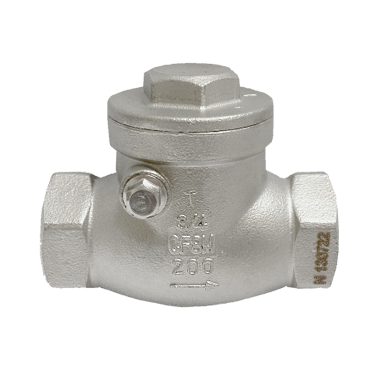
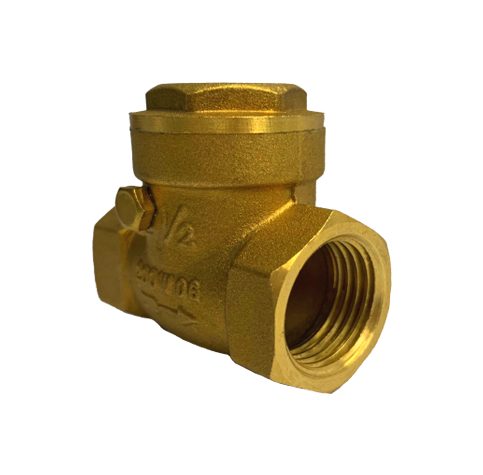
Overview
A comprehensive range of industrial isolation, non-return, regulating and strainer valves for water, air, steam, oil and general utility service. Chuan Kok stocks ball, gate, globe, check (swing/dual-plate/spring), butterfly and Y-strainer valves in SS316, cast steel, cast iron and brass — to ANSI, JIS and PN standards, in flanged, threaded and welded connections.
Buying from Chuan Kok
Wide selection ex-stock by material, pressure class and connection. Specify medium, temperature, line size and end connection and we'll recommend the right valve.
Standards & materials
- Flanged: ANSI 150#/300#, JIS 10K, PN10/16/40
- Threaded: 200 PSI / 800 PSI (WOG), BS/API
- Design/test: API 598 / BS 6755
Specifications
| Size Range | 1 1/2" to 4" |
| Design | Swing Type Check Valve |
| Material |
|
| Working Pressure | Up to 150# |
| Connections |
|
| Applicable Medium | General Oil, Gas & Water Applications |
| Temperature Range |
|
Specifications are indicative and vary by size and manufacturer. Request the full datasheet for exact dimensions, materials and certification.
Typical applications
- Water, seawater and utility distribution
- Compressed air and low-pressure gas
- Steam and condensate (rated types)
- Marine, building services and process lines
Ordering & procurement
Wide selection ex-stock by material, pressure class and connection. Specify medium, temperature, line size and end connection and we'll recommend the right valve.
Request a quoteAbout this range
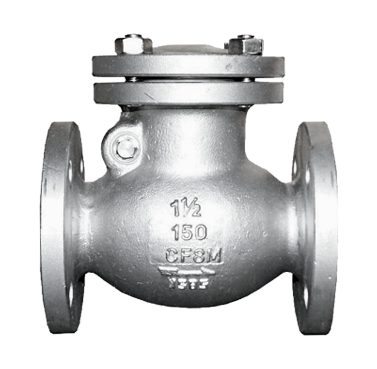
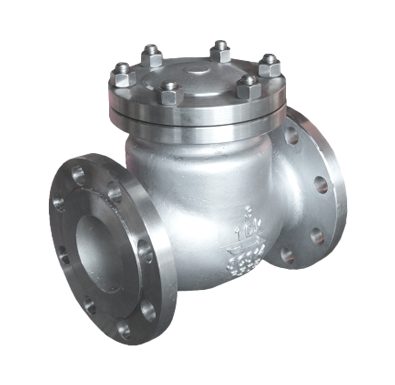
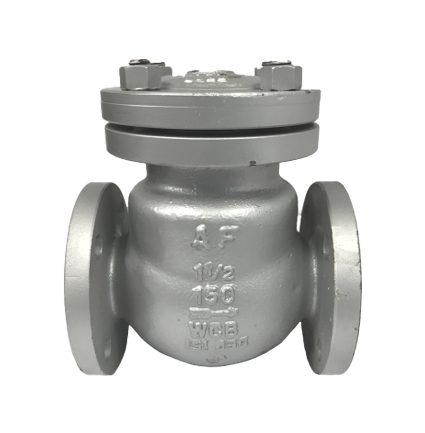
Swing Check Valve , also known as non-return valve or one way valve , is a valve with the purpose of controlling the fluids flow in one direction only . The design and manufacture of the valve is according to BS1868 & ASME B16.34 standard . There is an arrow directional shown on the valve body to present the direction of the fluids flow to. The feature of the swing check valve includes its two-port flange; the valve has two openings in the body, one for fluid to enter (inlet port) and another for fluid to move out (outlet port). Therefore, the fluids will flow from the inlet port, pushing the disc to swing upward and flow through the valve channel. If there is any backflow from the outlet, it will push the disc toward the inlet and prevent backflow. Swing check valve can be operated without any valve handle or stem, due to the reason that it can work automatically. The swing check valve is available in stainless steel (SS316) and cast steel material. Since the check valve works automatically, it can be operated without any valve handle or stem. Swing check valve provides stainless steel SS316 material.
Product information
1. How should a Swing Check Valve be installed?
The feature of the swing check valve is equipped with a disc that swings on a hinge or shaft. The valve flap swings away from the valve seat to allow forward flow. The valve flap swings back to the valve seat to avoid the reverse flow of fluids when the flow has stopped. Therefore, the weight of the disc and the return flow will have an impact on the closing characteristics of the valve.
Generally, levers and weights or levers and springs are installed to achieve the best performance. The swing check valve is suitable in the application where the risk of water hammer increases at the standard speeds. Swing check valve is suitable for high pressure, inadequate back pressure and high flow rate occasions as it has a lever.
One important thing to note is that it is not completely maintenance-free because the valve disc needs to be cleaned and maintenance is required from time to time.
ANSI 150# SS316 Flange End Swing Check Valve
2. What is the advantage of Swing Check Valve?
The benefit of swing check valve includes:
Ease of maintenance:
The key to the design of swing check valves is ease of maintenance. The bonnet assembly such as the hinge and disc for the valve can be removed from the valve by unscrewing a few bolts, and can be maintained. The seat is placed at an angle of 20°, providing tightness even at low back pressure. The hinge is made of acid-resistant stainless steel (SS316) and is firmly fastened around the shaft with bolts to eliminate play and ensure durability. In the case of limited available space, the hinge can be placed in reverse position.
Prevent water hammer:
When a lever and weight are installed, the small-sized swing check valve can be activated by manually moving the lever. It is able to achieve a gentle closing of the seat and an optimal closing speed by adjusting the weight on the lever in order to prevent water hammering. Water hammer can occur in any piping system that uses valves to control the flow of liquid or steam. A protective device covering the lever and weight can be used as an additional safety measure because it eliminates the risk of injury. The protective device is equipped with a limit switch for remote monitoring.
Economical option:
A swing check valve is a low cost type of check valve, the low cost of the valve allows them to utilize within a wide range of operation as the low project budgets. Swing check valve also provides a larger flow capacity, however, it does not support downward vertical flow, which has the limitation on serving different types of system.
3. Which is better: Spring Check Valve or Swing Check Valve?
A valve is a general-purpose device used to control the flow of liquid or gas. It is significant in the countless pipelines and process systems, as they are generally utilized for adjusting the flow and pressure, start, or stop flow, or prevent the fluids flow backward in the system. Swing check valves and spring check valves are two relatively common valve types that are widely used.
The swing check valve uses a swing flap to prevent reverse flow in a horizontal forward flow system. Spring check valves can also prevent reverse flow, in which case a spring-loaded plunger is used. Understanding the difference between these two valves can help determine the best valve for a specific system or application.
Swing Check Valve
In a swing check valve, the flapper will swing to allow fluid or gas to flow forward. When the flow needs to be stopped, the baffle will swing back to the valve seat and automatically close the valve as the system pressure decreases. The swing check valve is eye-catching due to its large flow. The usage of the swing check valve is limited to horizontal flow or vertical upward flow due to the fact that the valve itself requires a swing to perform. However, the swing check valve is suitable for various media, including liquid and gas. The general application for swing check valves such as fire fighting equipment, flood control of sewage systems, and toilet flushing mechanisms.
| Pros | Cons |
|---|---|
| Swing check valve is relatively low in cost, therefore it is able to work within a wider range of project budget. Meanwhile, it has a large flow capacity. | The application of the Swing check valve on the system is limited due to it cannot support downward vertical flow. It is also worth noting that swing check valves are also more likely to amplify water hammer. |
Spring Check Valve
Spring check valves generally contain a large plug and hollow body to allow the valve to undertake the pressure from the spring. When the fluids (including gas) flows at a sufficiently high pressure, the force will overcome the pressure from the spring to open the plug, thus allowing the required flow.
Unlike swing check valves, the noise level of spring check valves is quite low. They can also minimize the sound and destructive effects of water hammer. This type of valve works well in vertical applications because it uses a spring to close the valve instead of relying on gravity and pressure.
| Pros | Cons |
|---|---|
As the spring check valve can be used in vertical applications, it is more versatile than swing check valve and is likely to match pre-existing pipe configurations. Another advantage is the check valve function to reduce water hammer, this device is called a “silent check valve”, it enables to reduce noise levels in applications where swing check valves may exacerbate the problem. Apart from that, the pros of a spring check valve includes:
| High in cost and low flow capacity |
4. How to install Swing Check Valve?
A swing check valve can be installed in both horizontal and vertical direction. Before you install the swing check valve, you have to make sure the flow arrow is placed in the correct direction. If installed vertically, the flow arrow must point up, enabling the fluid flow through the pipeline to travel upwards, and avoid the gravity force pulling it back and contaminating the water supply.
The following steps will guide you on how to install a swing check valve:
- Step 1: Look inside the valve — ensure the valve does not have anything stuck inside the body. If a small object enters the swing check valve, it may cause the disc to jam and prevent all water flow.
- Step 2: Push the flapper away from the seat surface to check the operation and make sure it can move freely.
- Step 3: Ensure the flange end does not contain any burrs or edges that would prevent them from sealing properly.
- Step 4: Install the valve along the flow direction according to the flow arrow, ensuring that there is a straight pipe section of 3 times the diameter upstream.
- Step 5: If installed in a vertical position, the flow direction must flow upwards; if installed in a horizontal position, the valve must be installed with the cover facing upwards.
5. How do you maintain a Swing Check Valve?
A swing check valve does not require a lot of maintenance. However, if you want to ensure the effectiveness of the check valve, you can check them consistently. These problems may appear after a long period of service, which are:
1. Leakage at cover or flange end connection: The problem may be caused by bolts loosening or the gasket is damaged.
Possible Solution:
- Tighten the bolts, or replace the gasket (full faced flange gaskets are recommended).
2. Valve leaks when closed: The damage of the flapper or seating surface can be a reason that causes valve leakage.
Possible Solution:
- Inspect and clean the flapper, replace flapper if necessary.
- Inspect and replace the valve if the body is damaged.
3. Valve does not open: It may be due to the obstruction in the valve and cause it cannot be opened.
Possible Solution:
- Check for obstruction by disassembling the valve.
- Remove any debris or obstructions.
Downloads
Catalogues & literature
Catalogue
Having a hard time finding the right parts?
We stock 15,000+ line items and can source specials nobody else can. Get a quotation within 2 hours.