 Get a Quote
Low Pressure Valves
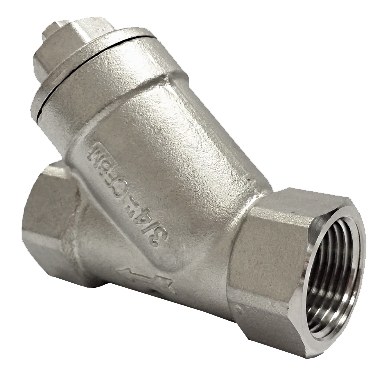
Y-Strainers
A comprehensive range of industrial isolation, non-return, regulating and strainer valves for water, air, steam, oil and general utility service. Chuan Kok stocks ball, gate, globe, check, butterfly and Y-strainer valves in SS316, cast steel, cast iron and brass.
- Protects pumps, nozzles and instruments from debris
- SS316 and cast steel bodies
- Threaded (BSPP/NPT) and flange end connections
- Horizontal or vertical installation




Overview
A comprehensive range of industrial isolation, non-return, regulating and strainer valves for water, air, steam, oil and general utility service. Chuan Kok stocks ball, gate, globe, check (swing/dual-plate/spring), butterfly and Y-strainer valves in SS316, cast steel, cast iron and brass — to ANSI, JIS and PN standards, in flanged, threaded and welded connections.
Buying from Chuan Kok
Wide selection ex-stock by material, pressure class and connection. Specify medium, temperature, line size and end connection and we'll recommend the right valve.
Standards & materials
- Flanged: ANSI 150#/300#, JIS 10K, PN10/16/40
- Threaded: 200 PSI / 800 PSI (WOG), BS/API
- Design/test: API 598 / BS 6755
Specifications
| Size Range | 1 1/2" – 4" (DN15 – DN100) |
| Working Pressure | Up to 800 PSI |
| Connections |
|
| Applicable Medium | General Oil, Gas & Water Applications |
| Material |
|
| Usage | Collect Containment and Particles |
| Temperature Range | -20°C to 230°C |
Specifications are indicative and vary by size and manufacturer. Request the full datasheet for exact dimensions, materials and certification.
Typical applications
- Water, seawater and utility distribution
- Compressed air and low-pressure gas
- Steam and condensate (rated types)
- Marine, building services and process lines
Ordering & procurement
Wide selection ex-stock by material, pressure class and connection. Specify medium, temperature, line size and end connection and we'll recommend the right valve.
Request a quoteAbout this range
Y-Strainer , also known as wye strainer, is a filtering device mechanically to separate solids and liquids from fluids, as well as capture dirt and debris. The main purpose of the Y-Strainer is to avoid particles from continuing to enter the system, ensuring that downstream components are not affected by particles in the fluid. It will have costly pipeline equipment such as pumps, engines, valves, and other equipment to protect from harmful flow contamination. The name of Y-Strainer comes from its Y-shaped form. The “Y” shape allows to filter or filter out particles in steam, gas or liquid. It has low resistance to fluid passages or straight passages, resulting in low-pressure loss. This is the reason why Y-type strainers are used in applications where only a small amount of solid particles are expected to be discharged and frequent cleaning is not required. The Y-Strainer mechanical strain process is fitted process fitted in many piping lines and it is made possible by a filter element composed of perforated metal body, mesh, perforated metal, or wedge-shaped wire strain elements. Some also include “ blow-off valves ” that allow the cleaning process easier in applications with more substantial dirt blowing. The Y-shaped strainer has better flow characteristics than the T-shaped strainer as the direction of the fluid changes less as it flows through the filter.
Product information
1. What is the purpose of Y-strainer?
Generally speaking, clean fluids help maximize the reliability and longevity of any mechanical system, it is particularly important for solenoid valves. The reason may be due to the solenoid valves being very sensitive to dirt and only functioning well with clean liquid or air. If any solid enters the stream, it can destroy or even damage the entire system. Thus, the Y-strainer is a good supplementary component. In order to maintain the performance of the solenoid valve, it also helps protect other types of mechanical equipment, such as:
- Pumps
- Turbines
- Spray nozzles
- Heat exchangers
- Condensers
- Steam traps
- Meters
A Y-strainer can protect these components (as mentioned above), and some of the most valuable and costly parts in the pipeline, from pipeline scale, rust, sediment or any other type of foreign debris. Y-Strainers have a variety of designs and connection types, which can be adapted to any industry or application.
2. What is the strainer mesh size?
If there is no mesh filter of the correct size, the Y-Strainer will not perform its function. In order to choose the most suitable strainer for a task, it is necessary to understand the basics of screen and mesh sizes. Mesh screen and microns are two reading terms used to describe the size of the holes in the filter to identify which fragments of different sizes pass through the filter and flow through the system.
The Y-Strainer mesh size is the amount of openings per linear inch of mesh. For instance, a 10 mesh screen has 14 apertures per inch, whereas a 120 mesh screen has 120 openings per inch and has a much smaller opening hole. The smaller the particle size allowed to pass through the filter, the lower the mesh number.
The micron is the unit of measurement for tiny fragments, and the micron is calculated as one thousandth of a millimeter or approximately one thousandth of an inch.
| MESH SIZE | MICRONS | INCHES |
|---|---|---|
| 10 | 2000 | 0.0787 |
| 12 | 1680 | 0.0661 |
| 14 | 1410 | 0.0555 |
| 16 | 1190 | 0.0469 |
| 18 | 1000 | 0.0394 |
| 20 | 841 | 0.0331 |
| 25 | 707 | 0.0280 |
| 30 | 595 | 0.0232 |
| 35 | 500 | 0.0197 |
| 40 | 420 | 0.0165 |
| 45 | 354 | 0.0138 |
| 50 | 297 | 0.0117 |
| 60 | 250 | 0.0098 |
| 70 | 210 | 0.0083 |
| 80 | 177 | 0.0070 |
| 100 | 149 | 0.0059 |
| 120 | 125 | 0.0049 |
Moreover, you can refer to the following table as an example of mesh sizes according to certain particles.
| MESH SIZES | MICRONS | EXAMPLE OF PARTICLE SIZE |
|---|---|---|
| 14 | 1400 | - |
| 28 | 700 | Beach Sand |
| 60 | 250 | Fine Sand |
| 100 | 150 | - |
| 200 | 74 | Portland |
| 325 | 44 | Silt |
| 400 | 37 | Plant Pollen |
3. Can a Y-strainer be mounted vertically?
Y-Strainer can be flexibly installed in a vertical or horizontal position, and the screen filter element and cap are adjusted downward. The fluid must enter the inlet downwards so that the filter screen can collect the solid matter in the filter at the lowest point for vertical installation. Y-Strainer is utilized in liquid applications, as the sand and gravel are two general contaminants that pose a risk to the application.
The strainer is connected to the main pipe of the system in a diagonal Y-shape. It is generally used in pressurized pipelines, liquid or gas, steam and vacuum or suction systems. Since the strainer has a lower dirt holding capacity than a basket strainer, it needs to be cleaned frequently. Simply open and close the valve to complete the screen cleaning without shutting off the water flow or removing the strainer.
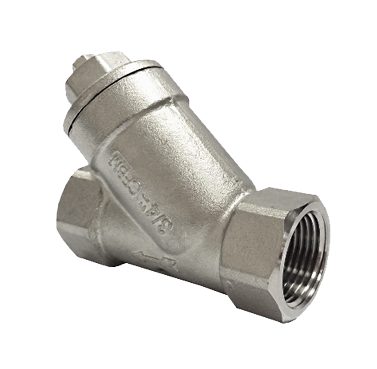
Threaded End SS316 Y-Strainer
4. How does a Y-strainer work?
Before the installation, there are several steps you need to be aware of:
(a) Before installing the strainer, make sure that the system is fully depressurized and all treatment fluid has been drained from the system. No machining fluids are allowed to go in the system during installation.
(b) Inspect the outside and inside of the strainer to make sure it is not defective or damaged.
(c) Kindly ensure the connection points are clean and no other particles.
The following steps are the appropriate instruction for installation:
- Align the strainer with the pipe according to the flow direction indicated by the arrow label on the filter body.
- Intend the other end of the male connector for tightening and connecting the strainer.
- The pipe where the filter is installed must be guided and assembled in a system without bending, stretching, and vibration.
- Before starting operating the system, make sure the installation is fully in place and the cap is facing down.
- Make sure that the bottom cover is closed and with no leakage before injecting liquid through the system. Start the system gradually to avoid the sudden impact on the strainer and piping system.
5. What are the applications of Y-strainer?
Y-Strainer acts as an important role in the environments which require continuous protection from debris and contamination. The following table shows the most common applications that require the use of a Y-Strainer.
| Application | Explanation |
|---|---|
| Steam Application | Y-Strainer is the preferred resource in most steam applications because its shape is designed to handle the high pressure. |
| Liquid Applications | Liquid tends to be penetrated by sand and gravel, Y-strainer can help prevent these particles from entering to ensure that the liquid remains clean. Particularly when it works in conjunction with other water treatment applications, the strainer can protect the important equipment from damage, corrosion, or blockage. |
| Natural Gas and Air Applications | Natural gas and air tend to have lower working pressures, therefore it is important to choose the right size to reduce the pressure drop from inlet to outlet. |
Downloads
Catalogues & literature
Catalogue
Having a hard time finding the right parts?
We stock 15,000+ line items and can source specials nobody else can. Get a quotation within 2 hours.