 Get a Quote
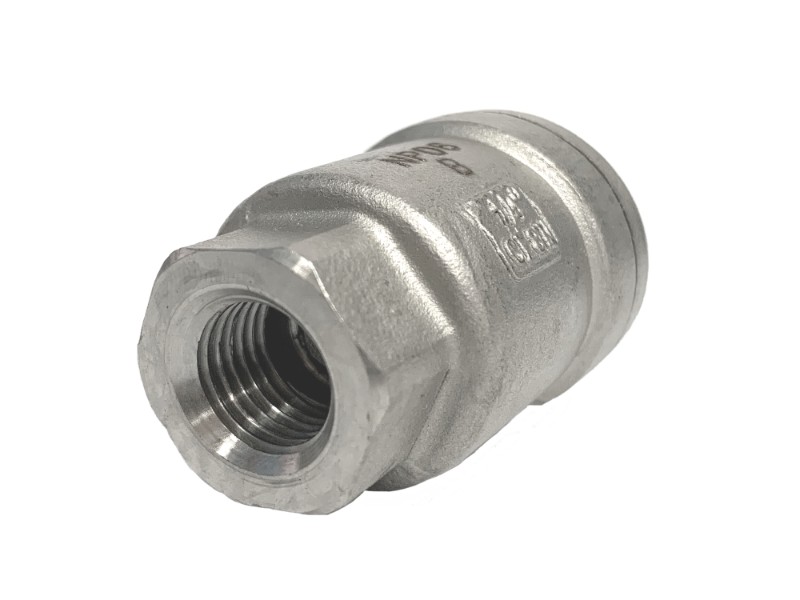
Low Pressure Valves
Spring Check Valve
Spring Check Valve. Spring-loaded poppet; suits vertical lines and pulsating flow. Body in SS316, rated Rated to standard. Material selected to suit the medium and pressure.
- Bubble-tight shut-off (soft-seated types)
- Corrosion-resistant materials
- Ex-stock in common sizes
- Actuation options on request
Specifications
| Size Range | 1/4" to 2" |
| Design | Spring Type Check Valve |
| Material |
|
| Seat Ring Type |
|
| Working Pressure | 1000 PSI |
| Connections |
|
| Applicable Medium | General Oil, Gas & Water Applications |
| Temperature Range | -29°C to +150°C |
Specifications are indicative and vary by size and manufacturer. Request the full datasheet for exact dimensions, materials and certification.
Typical applications
- Water, seawater and utility distribution
- Compressed air and low-pressure gas
- Steam and condensate (rated types)
- Marine, building services and process lines
Ordering & procurement
Ex-stock in Singapore, dispatched within 3 working days. Material / mill certificates (EN 10204 3.1) and export documentation available. Special sizes and materials sourced on request.
Product information
1. How does spring check valve work?
The check valve needs a differential pressure to work properly, and the move of the flow is from high pressure to low. Thus, when the high pressure on the inlet side is higher than the opening pressure, the fluid will pass through the check valve by overcoming the strength of the spring. The advantage of a spring check valve is simple to understand and user friendly as it is easy to install. The user needs to select the spring check valve according to the reliability and durability.
As mentioned, there are two types of sealing available, which is metal seats and soft seats. What is the difference between these two?
Soft seats — it is usually made of a thermoplastic material, such as Viton or PTFE. They are ideal for applications where chemical compatibility is important for tight sealing, enabling the valve to achieve a high level of sealing performance. Nonetheless, it is not recommended to apply soft valve seats for dirty or worn process fluids, as the seals may be damaged and cause valve leakage under these conditions.
Metal seats — the most advantage of the metal seats is the ability of withstanding high temperature, working pressure and harsh operating conditions. The metal seat can withstand severe flashing, abrasive process fluids, hydraulic shock, and high temperatures up to 573°C (1,000°F). They are suitable for highly corrosive or corrosive applications. Nonetheless, it provides relatively poor sealing performance between metal to metal, causing it easy to leak.
2. What does cracking pressure mean on a check valve?
Cracking pressure is the lowest limit upstream inlet pressure required to open the check valve to allow detectable flow. When the inlet pressure reaches the opening pressure, the spring in the valve will open, allowing the valve body to flow in one direction and preventing reverse flow. The standard cracking pressure is 0.5, 1.0 or 2.0 bar, which can be customized by the manufacturer during the production process. Different opening pressure can be customized according to the requirements.
To select a proper spring check valve for the installation, you may consider the technical specifications of the check valve, which include:
- Chemically compatible materials
- Minimum opening pressure
- How fast does the check valve close
- End connection options
- The reduction of pressure across the valve when it is fully open
When the inlet pressure is lower than the opening pressure, the spring forces the valve flap to close the orifice. The only disadvantage is that if the valve needs to be inspected or maintained and repaired, the valve needs to be completely removed from the pipeline for the procedure.
3. What is the application of spring check valve?
Spring check valves are ideal for multiple uses in water pipes and systems. This type of valve is used to protect equipment from possible damage caused by backflow, thereby reducing the risk of system downtime and potential contamination. Furthermore, this particular valve is able to release the system pressure to establish a safer environment for the normal operation of the system.
The internal spring improves the sealing and the immediate closing performance of the check valve. Therefore, it is suitable for installation in any position, both horizontal and vertical, or otherwise. Besides, it eliminates the influence of gravity on the characteristics of the check valve. If no spring is applied, gravity and the vertical direction of the check valve may become the key factors for normal operation.
4. Is a swing or spring check valve better?
A valve is a general-purpose device used to control the flow of liquid or gas. They play an important role in countless pipelines and process systems, and are usually used to adjust flow and pressure, start or stop flow, or prevent backflow in the system. Swing check valves and spring check valves are two relatively common valve types that are widely used.
The swing check valve uses a swing flap to prevent reverse flow in a horizontal forward flow system. Spring check valves can also prevent reverse flow, in which case a spring-loaded plunger is used. Understanding the difference between these two valves can help determine the best valve for a specific system or application.
Swing Check Valve
In a swing check valve, the flapper will swing to allow fluid or gas to flow forward. When the flow needs to be stopped, the baffle will swing back to the valve seat and automatically close the valve as the system pressure decreases. The swing check valve is eye-catching due to its large flow. As the valve requires a swing to function, the usage of the swing check valve is limited to horizontal flow or vertical upward flow. Swing check valve is suitable for various media, including liquid and gas. The general application for swing check valves such as fire fighting equipment, flood control of sewage systems, and toilet flushing mechanisms.
| Pros | Cons |
|---|---|
| Swing check valve is relatively low in cost, therefore it is able to work within a wider range of project budget. Meanwhile, it has a large flow capacity. | The application of the Swing check valve on the system is limited due to it cannot support downward vertical flow. It is also worth noting that swing check valves are also more likely to amplify water hammer. |
Spring Check Valve
Spring check valves generally contain a large plug and hollow body to allow the valve to undertake the pressure from the spring. When the fluids (including gas) flows at a sufficiently high pressure, the force will overcome the pressure from the spring to open the plug, thus allowing the required flow. Unlike swing check valves, the noise level of spring check valves is quite low. They can also minimize the sound and destructive effects of water hammer. This type of valve works well in vertical applications because it uses a spring to close the valve instead of relying on gravity and pressure.
| Pros | Cons |
|---|---|
As the spring check valve can be used in vertical applications, it is more versatile than swing check valve and is likely to match pre-existing pipe configurations. Another advantage is the check valve function to reduce water hammer, this device is called a “silent check valve”, it enables to reduce noise levels in applications where swing check valves may exacerbate the problem. Apart from that, the pros of a spring check valve includes:
| High in cost and low flow capacity |
5. Spring Check Valve Metal Seat Drawing:
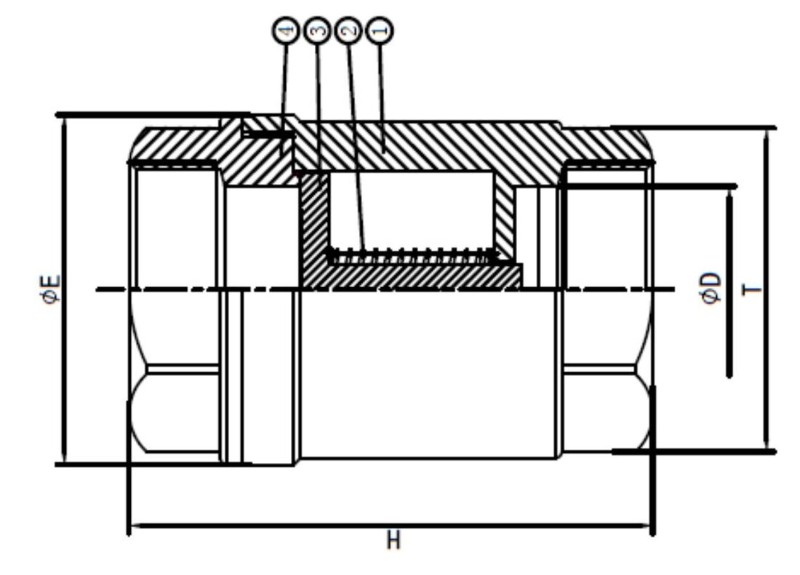
Spring Check Valve — Metal Seat Drawing
Material List:
| NO | PART NAME | MATERIAL |
|---|---|---|
| 1 | Body | SS316, CF8M |
| 2 | Spring | SS316 |
| 3 | Disc | SS316, CF8M |
| 4 | Cap | SS316, CF8M |
6. Spring Check Valve Viton Seat Drawing:
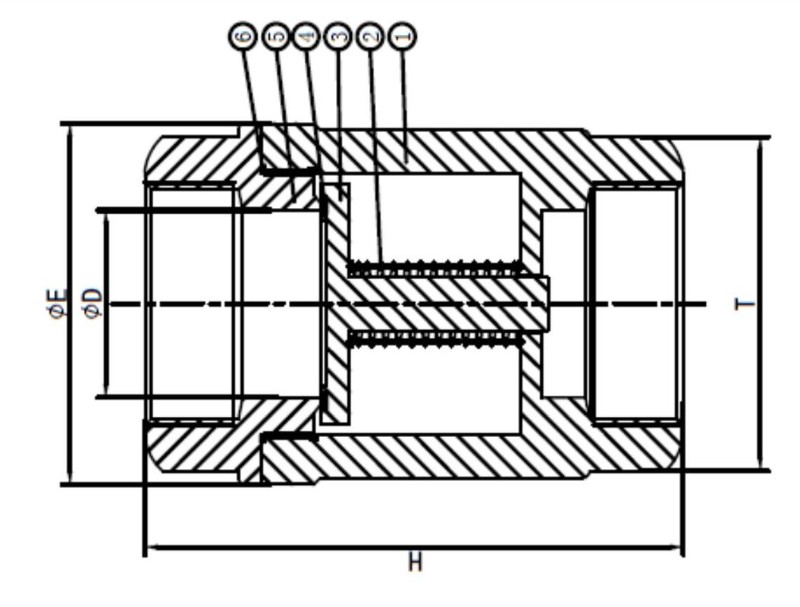
Spring Check Valve — Viton Seat Drawing
Material List:
| NO | PART NAME | MATERIAL |
|---|---|---|
| 1 | Body | SS316, CF8M |
| 2 | Spring | SS316 |
| 3 | Disc | SS316, CF8M |
| 4 | Seat Ring – (O-Ring) | Viton |
| 5 | Cap | SS316, CF8M |
| 6 | Seal Gasket | PTFE |
FAQ Of Spring Check Valves
What is the size range of spring check valves?
The size range of the spring check valves is from 1/4 inches to 2 inches.
What is spring check valves made of?
It is made of stainless steel SS316.
What is the working pressure of spring check valves?
The working pressure that spring check valves can withstand up to 1,000 psi.
What is the working temperature range of spring check valves?
The working temperature range of spring check valves is from -29°C to 150°C.
How many types of sealing for spring check valves?
There are two types of sealings which are soft seats and metal seats.
How to differentiate soft seats and metal seats?
Soft seats are generally made from thermoplastic material (eg. Viton or PTFE). They're ideal for tight-sealing applications that require chemical compatibility. In contrast, metal seats valves are manage to withstand high temperatures, working pressure and severe service conditions. They are great for high erosion or corrosion applications.
What is the function of spring check valves?
Spring check valves are used to prevent reverse flow and ensure one flow direction by utilizing a spring or back pressure to shut the valve.
Having a hard time finding the right parts?
We stock 15,000+ line items and can source specials nobody else can. Get a quotation within 2 hours.